
Friday, 18 December 2015


LO2: Production Schedule
A production schedule enables me, and any significant other, to have an accurate and detailed plan of what needs doing and when.


This is my production schedule:

Contingency Plan


Friday, 13 November 2015
LO2: Camera features and settings
Camera features and settings
Exposure

Exposure is the amount of light which the film (or light sensor) picks up. This is important because it determines the amount of illumination in a photograph. Overexposure is when too much light reaches the image sensor or photographic film and can cause details to be removed from the image, the opposite of this underexposure where not enough light reaches the sensor causing the image to become dark. A camera has several different 'Exposure modes' these include:
 |
| Image by Frans Lemmens |
Shutter Priority (S or TV) - In this mode, you set the shutter speed but the aperture is adjusted automatically so that you get the correct exposure. This mode is generally used to suggest motion in a photograph, this is done by having a longer exposure which makes objects appear blurry. This mode is often used in sports, where they use a short exposure so that the subjects appear 'frozen'.
Aperture Priority (A or AV) - Here you adjust the aperture so that you can choose what is in focus and how blurry the image may be. This is usually used for depth of field, by using a small aperture everything becomes blurred which creates a shallow depth of field and by using a large aperture everything becomes focused. Aperture is the size of the hole in which light is allowed to travel through the lens, this is measured in 'f-stops'. The smaller the f-stop (e.g f/2), the larger the hole meaning more light can travel through.
Auto (P) - This is where everything is done automatically by the camera, this is not very good when trying to make creative decisions because everything is done for you.
Photographic Lenses
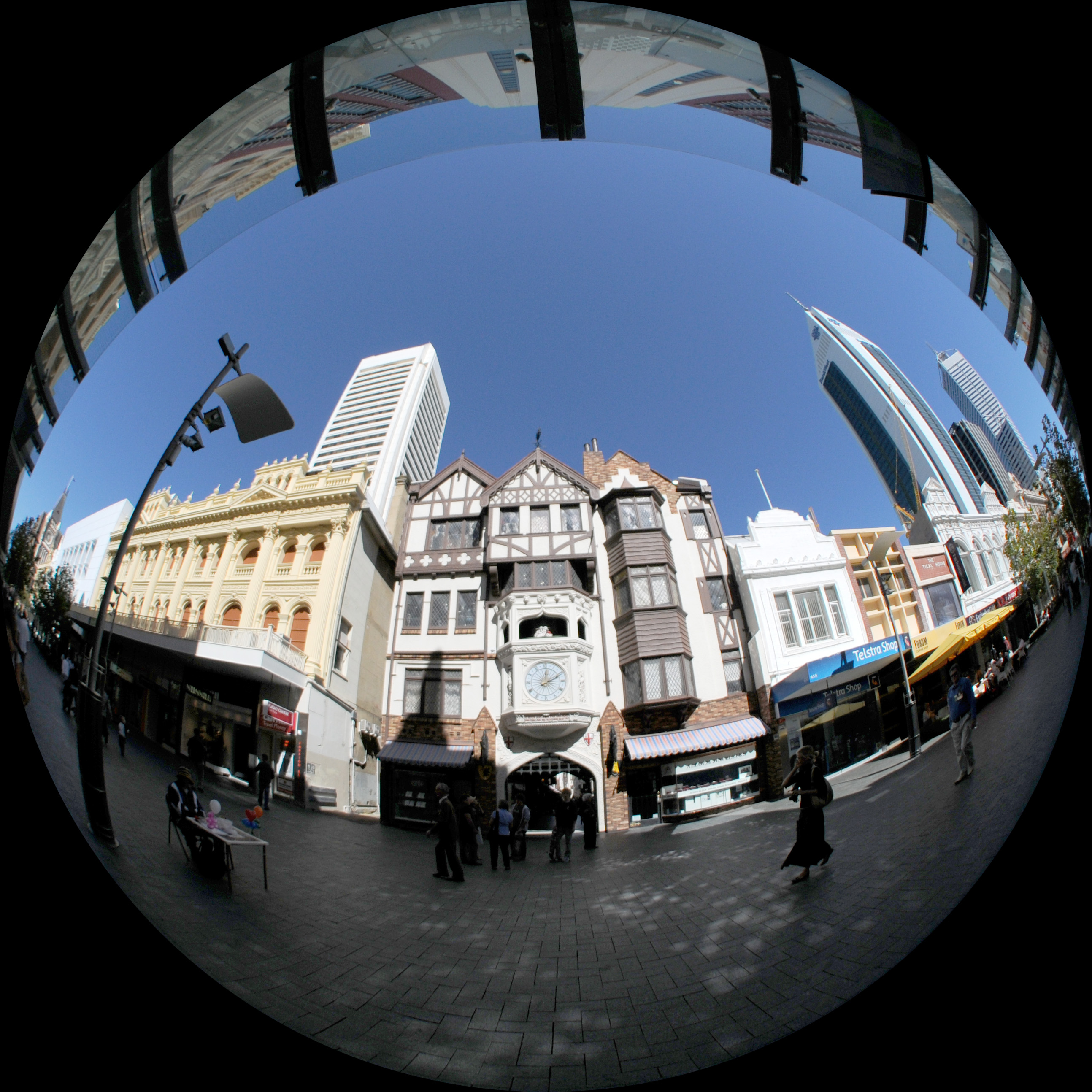
There are various types of lenses. The one that interests me the most is the fish eye lense because I think it gives a great perspective on things and really draws the eye in to the central part of the image. It makes the whole image look spherical and I think that is just a great effect.
I think it's highly possible that I will at least experiment with this lense but I will most likely only use a standard lense just because it is very simple to use. But it also gives a wider view of everything, which of course the fisheye lense does not.

Sunday, 1 November 2015
LO2: My theme - 'The Identity of Abnormality'
The theme I have chosen for this unit is 'The identity of Abnormality'. The reason I've chosen this theme is because I find it quite interesting and I think it could be quite surreal. My main reason for choosing this theme though is I can draw a lot of inspiration from my favorite photographer, Christopher McKenney.
In particular I want to take the idea of his excessive use of cloth, particularly to cover the face. I think that will put a sense of irony in the word 'Identity' because obviously the model will not be identifiable.


Locations
I also like McKenney's frequent use of woodlands, and as such I shall probably visit similar areas. I do however also like the idea as having abandoned buildings in the background to give my images a sense of the real world and abandonment.
The first image out of this selection is a close-up and so the background is actually just darkness. So images like this could be done in my own house or at college in front of a dark backdrop.
Equipment
Most importantly I shall need a camera, obviously. And I have decided to use the Canon 650d DSLR camera, which shall be supported using a tripod. I decided to use a digital camera because there is a large chance that I shall want to edit these files using Adobe Photoshop, which is made much easier when you have a digital image. I have decided to use a tripod at all times because I want my shots to be steady and clear.
Lenses
I would like to experiment with various lenses, but mostly the Fish Eye and Wide Angle lenses. I would like to use the Fish Eye because of its obscure view on the scenery which I think adds to the theme of abnormality and the frame can be made circular as opposed to the standard rectangular frame which I think makes the image more intriguing. Which brings me on to the Wide Angle as this does have a standard rectangular frame. The reason I'd also like to use the wide angle is because of it's smaller focal length. This will help me to make the foreground appear much more prominent and again enhance the idea of abnormality.
As a contingency I shall also take images with a standard lens, this won't have any effect on the image like the Fish Eye and Wide Angle however. So the reason I shall also be taking images with this lens is in the case that I decide I do not like the images taken with the latter two lenses.
Costume
Costume is quite a vital part of my theme because it helps to express the idea of abnormality. Like McKenney, I shall be wrapping my models in some sort of cloth (most likely bed sheets). I also want to use electrical tape to make very clear lines on my models, which I think will be more intriguing.
At the moment I am considering having one male model and one female. And so I want to use that to my advantage in my images. The female should wear a dress and tights, all black. And the man should wear a shirt, tie and jeans. The reason for this is to provide a contrast. The girl will be dressed in very dark clothing to match the dark nature of the photographic style, and the man shall be dressed in more casual clothing to bring forward that sense of abnormality coming in to reality.
Camera Settings
For all of my photographs I shall be using manual focus. This is so that I can capture the image exactly the way I want to. However, I may also take images in auto-focus as a contingency in case the final images come out blurry.
I am also contemplating taking some images around a fire. For this picture I shall have the ISO set to 200 to make the image relatively dark, but still clear. Until I am actually at the shoot I cannot specify a shutter speed though I think I will experiment with most speeds between 1/350 and 1/550, this is so that I can capture the motion of the flames actually in the photograph.
Risks
The main risk involved in taking these photographs is protecting the equipment, mostly due to it's expense. Because of this I have to make sure that the weather is appropriate at times of shooting and make sure I know the areas which I am shooting in as to help avoid theft risks.
Another issue is the costume being used, because it shall be directly covering the models face it means they are likely to suffer loss of breath. So because of this I have make sure they are in fact able to breath and may have to take short breaks in between sets of photographs so the models can get some air.
There is also a possibility I shall be using fire in my images and so of course that is a hazard. This means that I will always have to have my phone on me with full battery. Having water nearby might also be precaution to take.
Tester Shots
These are some tester shots of various locations I might use in my final shots.


Friday, 16 October 2015


Friday, 2 October 2015
LO1: Comparing photographs
Here I shall be comparing the photographs of the three photographers I have previously analysed. These photographs (top to bottom) were taken by Duncan Philpott, Paul Harries and Martin Parr
 |
| Photograph by Duncan Philpott |
 |
| Photograph by Paul Harries |
 |
| Photograph by Marin Parr |
Comparison
All of these photographs are landscape. Duncan does this to demonstrate the leading lines in the road. Martin and Paul however use this shot to give the viewer a full view of the subjects within the frame.
Both Duncan and Paul use black and white filters in their images to bring out the dark tones in their images. But Martin Parr uses a variety of vibrant colours in his image.
Paul Harries and Martin Parr both use a shallow depth of field to make the subjects in the foreground very clear to the audience. However, Duncan uses a deep depth of field to show where exactly the 'leading lines' are leading to.
Thursday, 1 October 2015
LO1: Treatment of the brief
 For this unit I have been asked to produce between five and ten photographs to be showcased in the Millenium gallery. I have chosen to specifically focus on 'the identity of abnormality'.
Concept Idea/ Costumes
The reason for this is I want to completely challenge the idea of what 'Identity' actually is, I will do this by covering the faces of the models in my photographs with black cloth.
I hope to achieve the effect of abnormality in my photographs mostly through it's content and a variety of camera angles. I shall mostly be using a shallow depth of field so that the viewer can concentrate on the models and general foreground.
I hope to achieve the effect of abnormality in my photographs mostly through it's content and a variety of camera angles. I shall mostly be using a shallow depth of field so that the viewer can concentrate on the models and general foreground.
Target Audience
My photographs shall be mainly aimed at 18-26 year old Males that will most likely be fans of Heavy Metal/ Djent type music and horror films because of the photograph's dark themes which I feel this type of audience would find more relatable.
I will also be targeting an audience that fit in to the BC1C2 categories of the ABC1 demographic system. The reason for this is that people who are enthusiastic about horror and dark music will likely spend a large amount of money on horror films, albums and other collectibles. This also means these people will likely have easy access to applications such as Instagram and Flickr where these photographs can be promoted.
Key Milestones
Researching other photographers - This should be done by 10th December 2015
Researching photographic techniques - This should be done by 10th December 2015
Making rough sketches of composition - This should be done by 6th January 2016
Taking tester shots - This should be done by 8th February 2016
All planning should be done by 20th February 2016
Practice photo shoot - This should be done by 29th February 2016
Taking final photographs - This should be done by 20th March 2016
Editing final photographs - This should be done by 15th April 2016
Launch Date - 31st April 2016
Legal and Ethical Considerations
It is important to make sure that the content of my photographs is entirely legal and ethical. For example if I was taking photographs in a public area, it's important I do not capture the image of any strangers without their explicit permission. In order to ensure that my models are entirely happy with being a part of this photo shoot they will need to sign consent and release forms so that I am able to display their photographs in a gallery.
LO1- Duncan Philpott
Duncan Philpott
Genre
Duncan Philpott is an Action/ Adventure sports photographer. Though he also does photo journalism which he describes as "Capturing the moment." He also does a lot of commercial photography, which is when his photographs are used for advertising purposes. And he also does a lot of personal photography, just for fun. This often includes using social networking sites, most notably Instagram, as this is a great way to showcase his work.Purpose and Meaning
As Philpott does a lot of commercial photography the purpose of his photography is generally to advertise.

Photograph analysis
I particularly like this image because it is, I think, a perfect definition of ''Capturing the moment'' which he himself stated was his aim. I think what immediately draws you in to this image is the use of leading lines. There are multiple sets of leading lines in this image and they all draw you towards (what appears to be) a firework in the centre. I also like the way he has used such a dark black and white filter so that he is really able to capture the light in the images, I think that creates a great contrast and makes the image more interesting.LO1 - Martin Parr
Martin Parr

Genre
Martin Parr is a photographer who focuses on the genre of photojournalism who is known for taking relatively intimate photo's which show a satirical view of like.He is most well known for his work that documents the social classes of England, which often show a humorous view of English life. On a broader scale he documents the general wealth of the western world.
Purpose and Meaning
This photograph (left) was taken in Hong Kong where his aim was to capture the "fashion, food and colour of Hong Kong." The photograph was then used for his photo-book "Hong Kong Parr". Which displays a selection of photographs he took whilst in Hong Kong.Photograph Analysis
This photo caught my interest because I think that it is quite comical but also intriguing, I would like to know where this is and what the man in the background is reading.
When adding the rule of thirds we can see that there isn't anything which specifically enters any of the four focal points, however both people cross over two sections meaning that both figures are very noticeable.
Focus is an important element used in this photograph. The focus is on the man in the foreground which shows the detail in the mans face and clothing. I think this is because the man in the foreground is more interesting because of his manner and what he is doing.
This photograph is also quite bright; though the background is ever so slightly out of focus it is still clearly visible because of the various bright colours. I think this captivates the viewer because it is not just a dull background, all of the image has some point of interest. This is important because it expresses Parr's aim of capturing "the colour of Hong Kong".
"Parr captures the intensity of urban life in Hong Kong." - The Independent, January 2015
LO1 - Paul Harries

Paul Harries
Genre
Paul Harries is a world renowned band photographer, most famous for his work with the Heavy Metal group 'Slipknot' from Des Moines, Iowa as well as his work with Kerrang! magazine.Purpose and Meaning
Harries' work is often used to promote bands. I particularly love Harries' work with Slipknot because of the way he is able to capture so much emotion in photograph's of masks. For example the image to the right features lead vocalist, Corey Taylor, and the band's late bassist Paul Gray.The photograph is called 'Brotherhood' and I think the positioning of the two members, general composition and black and white filter all come together to create an enormous amount of emotion in one picture, I think the title is also very important because it conveys how close the two members really were. The central positions of the two members creates a centre of interest, this with their gestures showcases the importance and the meaning of the image, I think, without having to necessarily be a fan of the band.
Photograph Analysis


I decided to see if Paul Harries had used the rule of thirds for this image (see left) because it looks incredibly well centred. However, though the eyes of the mask fit almost perfectly on the line there is nothing really surrounding the 'points of interest' so I decided that he did not use this photography technique to create this image. I think the reason the eye is drawn to the centre is rather to do with the level of detail the photograph captures despite it being in black and white. The mask is not clean and brand new; it is dirty and it has obviously been used. I think that really gives a sense of reality to the image as well as reflecting their music, which is obviously very important for Paul Harries, it's raw and it's not at all fabricated and I think that is why I appreciate his work so much.
LO1: Photography Techniques
Composition
Composition is the way in which everything is organised within the frame. This is very important in photography because as a photographer you must decide what the main focal point of your image will be.

For example in this image by Bensliman Hussan your eye is instantly drawn to the Eiffel Tower.
You could argue that your eye is drawn to this strictly because it is a well recognized landmark, but in terms of composition this image is made up of four parts - the ground, the sky, the person and the eiffel tower.
Colour is also very important in this image as the dark orange of the sky helps to outline the Eiffel Tower. Due to the lighting there is a huge contrast in colour between the sky, person and Eiffel Tower.
Another technique used in this image, sort of, is leading lines. The Squares on the ground are carefully composed in the image so that the eye is again lead to the Eiffel Tower.
Leading Lines

As I have just mentioned, Leading Lines is a technique used in photography to lead the eye to a particular part of an image.
It's a very interesting technique, I think, and is used to create spectacle in an image. Angles can be very important when using leading lines in an image because if your photograph is just taken randomly you might not be able get that perfect line-up of shapes like in this image.
Centre of Interest

I'm not sure I need to explain this one but basically Centre of Interest is when the thing of interest is in the centre. The image to the left was taken by Kim Braden and is called 'Dominant Center of Interest' because that is indeed what it is.
The striking colours of the hot air balloon against the simple blue of the sky means that your eye is straight away drawn to the centre of the image. Like alot of photography techniques this all comes back to composition. The photograph has been perfectly composed so that the Hot Air Balloon sits almost exactly in the middle. It's almost as though the rest of the image is just there to frame the centre... and that brings us straight on to our next photography technique.
Framing

This photograph is called 'Black and White House' and was taken by Scott Ableman and is an excellent example of framing in my opinion. It creates spectacle through an using an interesting shape.
Framing is a technique in photography that can be done in numerous ways. It's a great way of adding interesting shapes to your photographs and again is used to draw the viewer's eye to a particular area of the photograph.
Colour

Colour is used in photography to create spectacle. Manipulating colour is a good way to change people's perception of a photograph. It's also used to evoke certain emotions.
In this image blue and red is used and slightly offset from eachother to give it that cool traditional 3D look. By using a plain backdrop the photographer is able to almost force the viewer to look at the model. The clashing of the colours in the centre makes the image even more interesting I think. This is certainly, to me, the most interesting photography technique and so it's highly likely that I shall play around with this when editing my photographs.


LO1- A good photograph
A good photograph
In my opinion, a good photograph is something which instantly catches the eye. The image should send the viewer a message, or a story. And the long you look at it, the more intrigued you should become. This could be done with interesting lighting, a quirky composition or quite plainly just an image of something different.
When I take my photographs, I shall bare this in mind. Particularly as it shall be for a media product so therefore it is a main goal to catch peoples eye and make them see something different, something which will make them want to purchase that product.
One of my favourite photographers is Chris McKenney, because he creates really interesting images. His themes are usually really dark, but catch your eye and tell the audience a story.
Unfortunately, his work is not ideal for media products though his use of lighting and photo 'doctoring' means he would still be good to draw inspiration from.

Subscribe to:
Posts (Atom)